Business trip plan
- Entries on the itinerary
- 12
- Computed on this page from the inputs below
- Hours in transit (flights plus one hour per transfer)
- 10
- Computed on this page from the inputs below
- Hours of buffer the plan reserves
- 5
- Computed on this page from the inputs below
- Days to adjust at the usual one time zone a day
- 3
- Computed on this page from the inputs below
Every figure here comes from the figures you enter and the method stated beside it: your fares, your nights, your hotel rate, your ground transport, your company's own allowance and caps. Where a worksheet borrows a public figure as a default, the federal standard lodging and meals rates for instance, the page names the source and the date it was read.
Email me this result
We will send you these figures and a link back to them. One email, nothing else unless you tick the box.
The figures above are one trip worked as an example (12). Put your own fares, nights and caps in and the answer follows as you type.
Download the Business trip plan worked example (CSV)
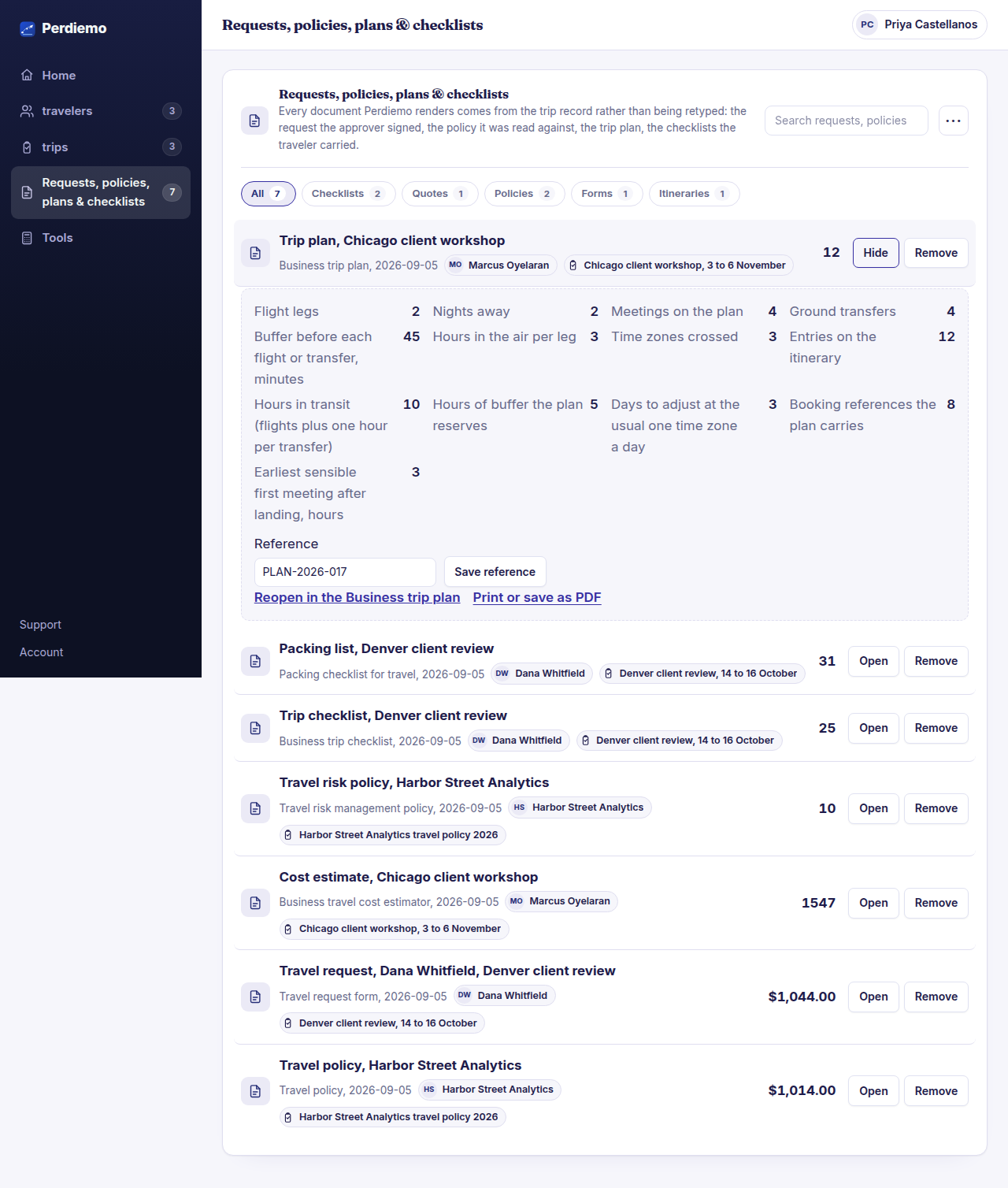
The business trip plan builds the itinerary from the bookings rather than from a blank page: the flight legs, the nights, the meetings, the ground transfers, the buffer the company wants before each flight or transfer, the hours in the air per leg and the time zones crossed. It returns the entries on the itinerary, the hours in transit, the hours of buffer the plan reserves, the days the traveler needs to adjust, the booking references the plan carries and the earliest sensible first meeting after landing, so the office can see whether the plan is possible before the meetings are confirmed.
Why the plan is built from the bookings
An itinerary written from memory has the flight at the wrong time and the hotel at the old address. Building it from the legs, the nights and the transfers means every entry has a booking reference behind it, and the count of references the plan carries is the count of things that can go wrong. On the worked example that is eight, and each one is on the trip in Perdiemo Pro with its reference.
Transit and buffer are the hours nobody plans
Two three-hour legs and four transfers are ten hours in transit before a single meeting, and a forty-five minute buffer before each of six departures is another four and a half. The worksheet adds them so the plan does not put a client meeting two hours after landing across three time zones; the earliest sensible first meeting is shown as a figure, not a hope.
The time zones and the first day
Three time zones is three days to adjust at the usual one zone a day, which means the first day's meetings are the ones to keep light. The plan shows the adjustment days beside the meetings so the office can move the important session to the second day. Pro keeps the plan against the trip and re-reads it when a flight moves.
What the office manager asks before using the Business trip plan
Which figures do I need before using the business trip plan? The flight legs, the nights, the meetings, the ground transfers, the buffer you want before each departure, roughly the hours per leg and the time zones crossed. The bookings give you all but the buffer, which is the company's own rule.
What should a business trip itinerary include? Every leg with its reference and times, every night with the hotel and its address, every meeting with its contact and location, every transfer, and the emergency contacts. The worksheet counts the entries and Pro renders the plan from the trip's own bookings.
How much buffer before a flight? The company's rule, entered here; forty-five minutes before a transfer and more before an international departure is common. The worksheet reserves the buffer per departure and shows the hours it adds so the office knows the plan is honest.
Where the method in this worksheet comes from
US Department of Transportation, Fly Rights: the 24-hour reservation rule, refunds and what an airline owes a passenger. Why every leg carries its reference and times: Fly Rights sets out what a passenger is owed on a delay or cancellation, and the traveler with the plan in hand is the one who can act.
US Department of State, Smart Traveler Enrollment Program (STEP): enrolling a trip so the embassy can reach the traveler. Why international itineraries carry the enrollment and the embassy contact: STEP is how the embassy reaches the traveler, and the plan is where the traveler looks.