Travel risk management policy
- Destinations on the risk register
- 10
- Computed on this page from the inputs below
- Check-ins the policy will generate a year
- 48
- Computed on this page from the inputs below
- Hours of pre-trip briefing a year
- 3
- Computed on this page from the inputs below
- Escalation contacts the policy names (manager, alternate, one per elevated destination)
- 4
- Computed on this page from the inputs below
Every figure here comes from the figures you enter and the method stated beside it: your fares, your nights, your hotel rate, your ground transport, your company's own allowance and caps. Where a worksheet borrows a public figure as a default, the federal standard lodging and meals rates for instance, the page names the source and the date it was read.
Email me this result
We will send you these figures and a link back to them. One email, nothing else unless you tick the box.
The figures above are one trip worked as an example (10). Put your own fares, nights and caps in and the answer follows as you type.
Download the Travel risk management policy worked example (CSV)
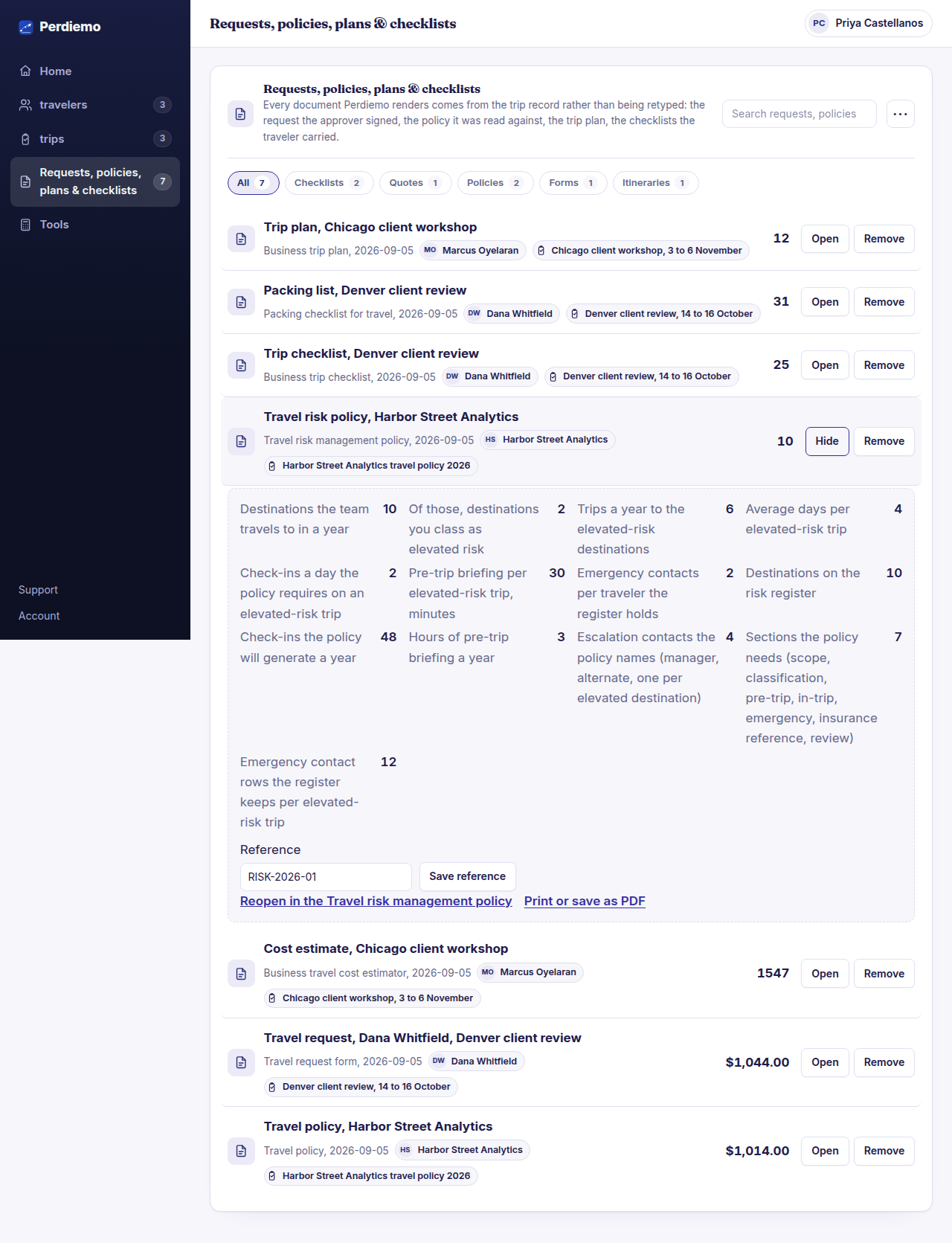
The travel risk management policy worksheet sizes the duty-of-care half of a small company's travel from the destinations the team actually goes to: how many there are, how many the company classes as elevated risk when read against the State Department advisory level for the country, how many trips a year go to those, how long they last, how many check-ins a day the policy requires, how long the pre-trip briefing takes and how many emergency contacts the register keeps per traveler. It returns the destinations on the risk register, the check-ins the policy will generate a year, the briefing hours, the escalation contacts the policy names, the seven sections the document needs and the contact rows the register keeps.
Why the policy is sized from destinations, not from fear
A policy that treats every trip as dangerous is ignored by the second week. Classifying destinations, with the State Department's advisory level as the reference and the company's own judgement on top, means the ordinary trip to a client in the next state gets the ordinary rules and the trip to a level 3 country gets a briefing, a check-in schedule and named contacts. The worksheet counts what that classification commits the office to.
Check-ins and escalation are the operational core
Two check-ins a day on a four-day elevated-risk trip is eight messages the office has to notice and one it has to act on if it is missed. The worksheet multiplies that by the trips a year so the office knows the load before it promises it, and names the escalation contacts (a manager, an alternate, and one per elevated destination) so a missed check-in has a next step written down.
The seven sections and the register behind them
Scope, destination classification, pre-trip (briefing, enrollment, health notices), in-trip (check-ins, contacts, what to do if), emergency (who is called and in what order), insurance reference (a pointer, not a policy) and the review date. Perdiemo Pro keeps the register the policy refers to: every traveler away, the destination's class, the hotel, the flights, the emergency contacts and the check-ins made.
What the office manager asks before using the Travel risk management policy
Which figures do I need before using the travel risk management policy worksheet? A list of the destinations the team travels to, your own view of which are elevated risk after reading the State Department advisory for each, the trips a year to those, their length, the check-ins a day you would actually monitor, the briefing time and how many emergency contacts you keep per traveler.
What is duty of care for business travel? The employer's obligation to take reasonable steps for a traveler's safety while away on the company's business. This policy is what makes 'reasonable steps' specific: classification, briefing, check-ins, contacts, escalation. It is a policy and a register, not a legal opinion.
Should travelers enrol in STEP? For trips outside the United States, the State Department's Smart Traveler Enrollment Program lets the embassy reach the traveler in an emergency and is free; the pre-trip section of the policy can require it for elevated-risk destinations and Pro records the enrollment against the trip.
Where the method in this worksheet comes from
US Department of State, Travel advisories: the advisory level for every country, levels 1 to 4. Why the destination classification is the company's own with the advisory level as the reference: the State Department publishes a level 1 to 4 advisory per country and the policy reads it on the day rather than copying it.
US Department of State, Smart Traveler Enrollment Program (STEP): enrolling a trip so the embassy can reach the traveler. Why enrollment is a pre-trip item for elevated-risk destinations: STEP is how the embassy reaches a traveler in an emergency, and it costs nothing.
CDC Travelers' Health: destination pages with the health notices and vaccines for a country. Why the pre-trip section covers health notices: the CDC destination pages carry the notices and vaccines for a country, and the briefing reads them.